
Finding Open Doors: Bringing BD SUMHAC's Behavioral Health Access Research to the World Stage
A new study from BD SUMHAC's state advocacy program asks a practical but urgent question: can relationship-building with local facilities open doors for people with bleeding disorders who need behavioral health care?
Authored by: The BD SUMHAC Team
On the World Stage in Kuala Lumpur
In April, BD SUMHAC had the honor of presenting our work at the World Federation of Hemophilia (WFH) 2026 World Congress in Kuala Lumpur, Malaysia — one of the most prestigious gatherings in the global bleeding disorders field.
Our poster presentation brought a straightforward but important question to an international audience: can we increase access to inpatient and residential behavioral health facilities through outreach and education?
For many people with bleeding disorders, access to behavioral health treatment remains difficult. Patients are often turned away not because treatment is not clinically appropriate, but because facilities are unfamiliar with bleeding disorders, uncertain about infusion medications, or operating under blanket admission policies that exclude anyone using IV or infusion-based treatments.
BD SUMHAC has spent years working to dismantle these barriers through provider and patient toolkits, federal Section 504 advocacy, updates to ASAM clinical guidelines, MASAC Recommendation 289, and a state advocacy program now active across eight states.
This project represents another step forward: a pragmatic, ground-level effort to test whether access can improve simply by building relationships with local facilities and helping them understand that caring for someone with a bleeding disorder is often far less complicated than they fear.
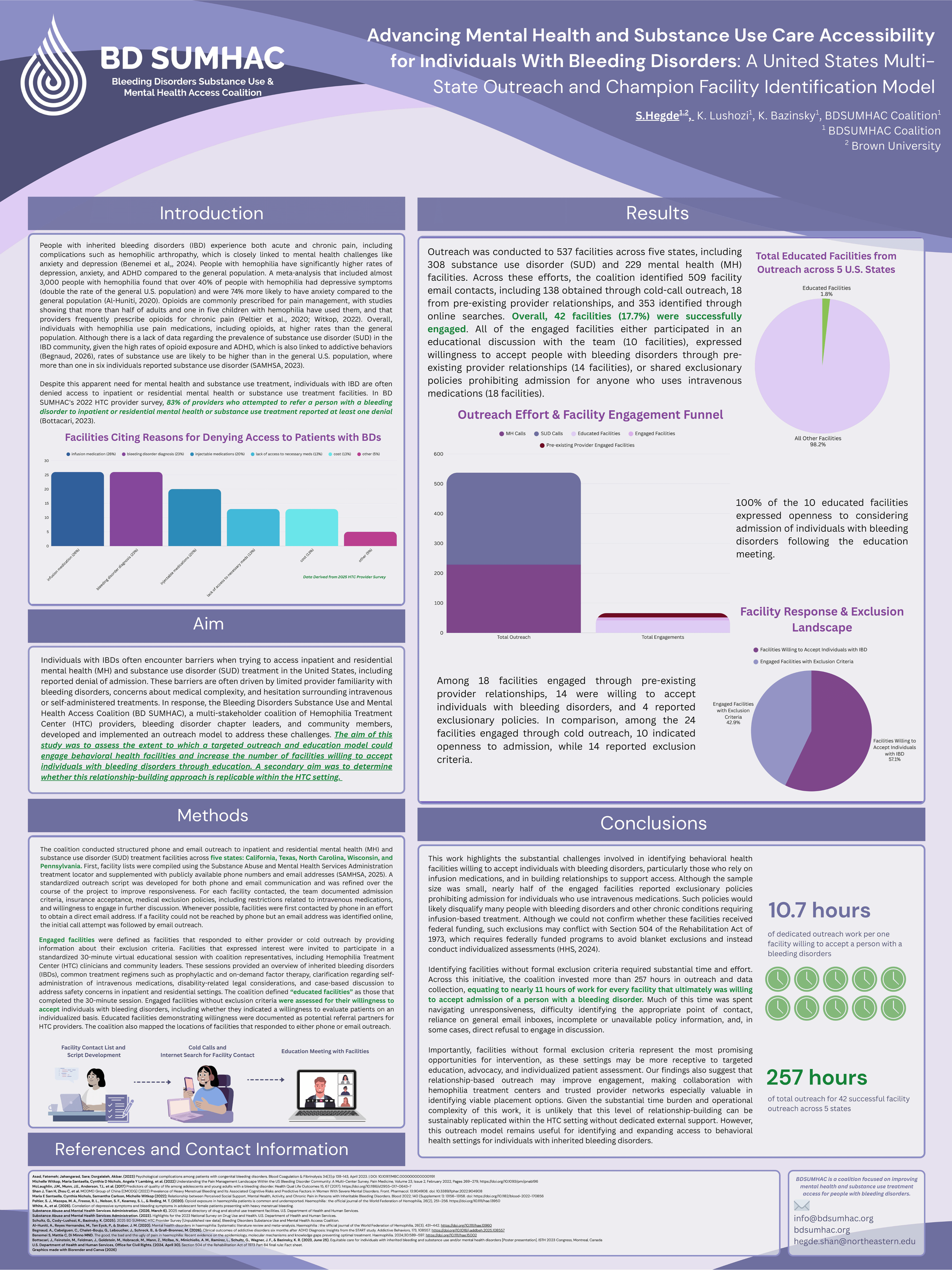
Poster presented at the WFH 2026 World Congress, Kuala Lumpur, Malaysia.
What the Project Did
Because behavioral health facilities often have significant discretion over which patients they admit, BD SUMHAC wanted to test whether proactive relationship-building — before a patient is in crisis — could shift that discretion in our community's favor.
The project had a practical goal: identify facilities willing to accept people with bleeding disorders who use infusion medications, and where possible, educate facilities that were uncertain but not categorically opposed.
Through the state advocacy program, the coalition conducted structured phone and email outreach to inpatient and residential mental health (MH) and substance use disorder (SUD) treatment facilities across five states:
California
Texas
North Carolina
Wisconsin
Pennsylvania
How It Worked
Facility lists were compiled using the SAMHSA treatment locator and supplemented with publicly available contact information. A standardized outreach script was developed and refined over time.
For each facility, the coalition documented:
Admission criteria
Insurance acceptance
Medical exclusion policies
Policies regarding IV or infusion medications
Willingness to continue discussions with the coalition
Facilities that expressed interest were invited to participate in a 30-minute virtual educational session with coalition representatives, including HTC clinicians and community leaders.
These sessions covered:
Basics of inherited bleeding disorders
Common treatment regimens
Self-administration of infusion medications
Relevant legal and disability-rights considerations
Case-based discussions addressing patient safety concerns
What the Coalition Found
The coalition contacted 537 facilities in total:
308 substance use disorder treatment facilities
229 mental health treatment facilities
Key Findings
537
Total facilities contacted across five states
42 (17.7%)
Facilities successfully engaged, meaning they provided policy information or agreed to further discussion
18 of 42
Engaged facilities reported blanket exclusion policies prohibiting admission for anyone using IV medications
10
Facilities completed the full 30-minute educational session — and every one of them expressed openness to considering patients with bleeding disorders afterward
257 hours
Total outreach hours invested — nearly 11 hours of work for every facility ultimately willing to consider admission
The most common reasons facilities cited for denying access included:
Infusion medications (26%)
Bleeding disorder diagnosis itself (23%)
Use of injectable medications (20%)
Lack of access to necessary medications (13%)
Cost concerns (13%)
Relationships Changed the Outcome
Among facilities engaged through pre-existing provider relationships, 14 of 18 (78%) indicated willingness to accept individuals with bleeding disorders.
Among facilities contacted through cold outreach alone, only 10 of 24 (42%) expressed openness.
That gap tells an important story: when trust already exists, the path to access becomes substantially shorter.
The educational sessions also produced striking results. Every facility that completed the 30-minute session expressed openness to considering admission for a patient with a bleeding disorder.
Every facility that completed our educational session expressed openness to admitting a patient with a bleeding disorder.
A Legal Dimension Worth Noting
Nearly half of the engaged facilities reported blanket exclusion policies related to IV medication use. These policies disqualify many people with bleeding disorders and likely affect individuals with many other chronic conditions requiring infusion-based treatment.
These exclusions may conflict with Section 504 of the Rehabilitation Act of 1973, which requires federally funded programs to conduct individualized assessments rather than applying categorical exclusions based on disability-related medical needs.
BD SUMHAC has worked actively on Section 504 advocacy and regulatory strengthening in this area. While the coalition could not confirm federal funding status for every facility contacted, the prevalence of blanket refusals raises serious civil rights concerns that deserve continued attention from advocates, providers, and policymakers.
What This Research Contributes
This project contributes something the field has largely lacked: documented evidence of what happens in real time when someone attempts to access behavioral health treatment, and what interventions may improve those outcomes.
Importantly, these barriers are not unique to the bleeding disorders community. Any person living with a chronic condition that requires infusion-based treatment may encounter similar obstacles.
The findings contribute to a growing body of evidence showing a broader systemic access gap that extends far beyond inherited bleeding disorders alone.
Future research could explore:
Whether these patterns persist across additional states and regions
Whether expressed willingness ultimately translates into successful admissions
What sustained support models are most effective for HTCs navigating placement challenges
BD SUMHAC's outreach model offers a replicable framework for continued research and advocacy, and we hope others will build on this work.
A Note for HTC Providers
The investment required for this work is significant: 257 hours of outreach to identify 24 facilities willing to discuss admission across five states.
That is not a sustainable burden for any single HTC to carry alone without external support. At the same time, the findings clearly demonstrate what becomes possible when dedicated outreach capacity exists.
Recommendations for Providers
Start building relationships before a patient is in crisis.
Identify one or two local behavioral health facilities without blanket exclusion criteria and begin conversations now, before urgent placement needs arise.
Use the tools BD SUMHAC has already developed.
The outreach model, educational materials, and standardized scripts created through this project were designed to be replicated and adapted.
Advocate for dedicated support and staffing.
Relationship-building and placement coordination require meaningful time investment and sustainable funding.
Document every denial.
Patterns drive policy change. Systematic documentation strengthens future advocacy efforts and helps demonstrate the scope of the problem.
Thank You: Shanthi and Our State Advocacy Teams
A special thank you to Shanthi Hegde, MPH student at Brown University and BD SUMHAC intern, whose tireless work made this project possible.
Shanthi conducted phone outreach, identified facility contacts, maintained detailed documentation throughout the project, and brought exactly the kind of persistence this work demands.
Presenting at WFH 2026 is a well-earned recognition of that effort, and we are proud to have had her on the team.
We also extend our deep gratitude to the state advocacy teams across California, Texas, North Carolina, Wisconsin, and Pennsylvania for leveraging existing relationships, participating in outreach, leading educational meetings, and representing the community with expertise and care.
This work is only possible because people consistently show up to do it.
To Shanthi, our state advocates, HTC clinicians, and every community leader who contributed time and expertise to this project: thank you. This is what BD SUMHAC is made of.
About BD SUMHAC
BD SUMHAC — the Bleeding Disorders Substance Use and Mental Health Access Coalition — is a multi-stakeholder coalition of Hemophilia Treatment Center (HTC) providers, bleeding disorder chapter leaders, and community members dedicated to ensuring that people with inherited bleeding disorders can access the mental health and substance use care they need.
Why This Work Matters
People with inherited bleeding disorders experience both acute and chronic pain, including complications such as hemophilic arthropathy, which is closely associated with anxiety and depression.
Research shows:
People with hemophilia are more than twice as likely to experience depression as the general population
Individuals with hemophilia are 74% more likely to experience anxiety
More than 40% of people with hemophilia report depressive symptoms — roughly double the national average
Opioids are commonly prescribed for bleeding disorder-related pain. More than half of adults and one in five children with hemophilia have used opioid medications.
Given elevated rates of opioid exposure and ADHD — itself associated with increased risk for addictive behaviors — substance use disorder rates within the inherited bleeding disorders community are likely higher than in the general population, where more than one in six people already report a substance use disorder.
Despite this clear need, people with bleeding disorders are routinely denied access to inpatient and residential behavioral health care.
BD SUMHAC's 2022 HTC provider survey found that 83% of providers who attempted to refer a patient to inpatient or residential mental health or substance use treatment reported at least one denial.
The most common reasons included:
Facility unfamiliarity with bleeding disorders
Concerns about infusion medications
Blanket exclusion policies
What BD SUMHAC Has Done About It
Since its founding, BD SUMHAC has pursued this mission on multiple fronts:
Developed provider and patient toolkits to support navigation of behavioral health systems
Advocated for stronger enforcement and updated regulations under Section 504 of the Rehabilitation Act of 1973
Worked with the American Society of Addiction Medicine (ASAM) to update clinical guidelines for patients with complex medical needs
Collaborated with MASAC to establish Recommendation 289 on behavioral health access for people with bleeding disorders
Built and implemented a replicable state advocacy model operating across eight states
Conducted the outreach and education project described in this article, contributing new evidence about barriers and solutions
To learn more about BD SUMHAC's work or get involved, contact the coalition at info@bdsumhac.org.
This article is based on the poster presentation “Advancing Mental Health and Substance Use Care Accessibility for Individuals With Bleeding Disorders: A United States Multi-State Outreach and Champion Facility Identification Model,” presented by S. Hegde, K. Lushozi, K. Bazinsky, and the BD SUMHAC Coalition at the WFH 2026 World Congress in Kuala Lumpur, Malaysia.